
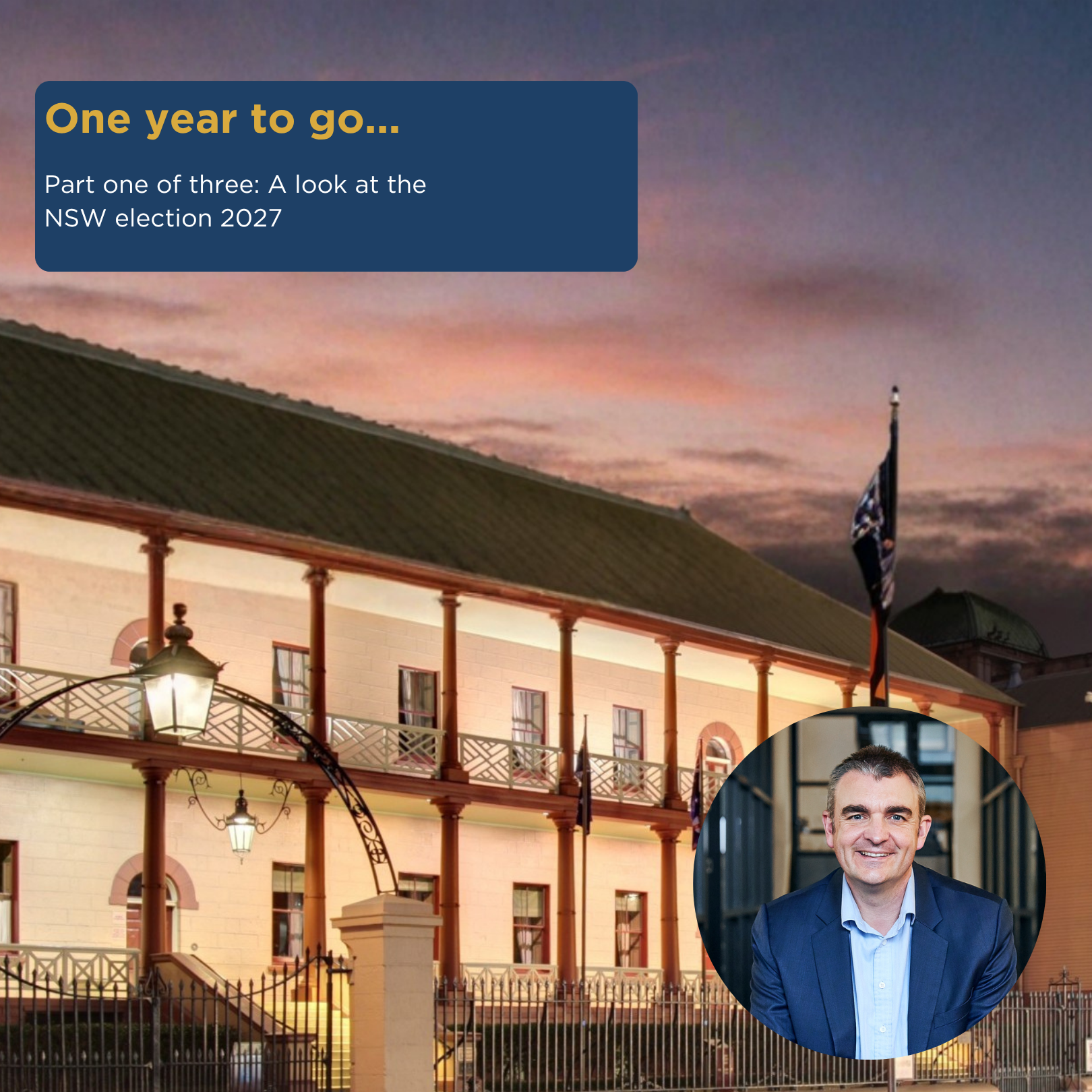

This past Saturday marked exactly one year until the 2027 New South Wales state election. On 13 March 2027, Premier Chris Minns will seek a second term against Opposition Leader Kellie Sloane’s Coalition – and the latest polling makes him a clear favourite to retain government. The more consequential question is not whether Minns survives, but by how much: majority government or another term of minority rule. That distinction will determine the regulatory and legislative operating environment for every business in NSW for the four years that follow. For executives, the starting gun has fired.

THE STATE OF THE RACE
Why Minns is the favourite
The most authoritative read of the NSW political landscape right now is the DemosAU poll conducted between 24 February and 4 March 2026 – the most recent state-specific survey published, with a sample of 1,032 voters. The headline primary vote result puts Labor at 34 per cent, One Nation at 21 per cent, the Coalition at 23 per cent, and the Greens at 15 per cent. If preferences flow as they did at the 2023 state election, that translates to a two-party preferred result of 61–39 to Labor.
The critical analytical point is how NSW’s optional preferential voting system works. Under optional preferential, voters are not required to number every box, and a significant proportion do not. That means a split conservative primary vote between the Coalition and One Nation does not automatically deliver its full preference value to the Coalition. DemosAU Head of Research George Hasanakos was direct: history has shown that when the vote of one side of politics is split under option preferential, it benefits the other major party. Labor, holding the highest primary vote of any single party at 34 per cent, enters 2027 with a structural advantage that the raw primary numbers alone do not fully convey.
“History has shown that when the vote of one side of politics is split under optional preferential, it benefits the other major party.” – DemosAU Head of Research, March 2026
The personal dimension reinforces the structural one. Minns leads Sloane 48–24 as preferred premier, a margin that has grown since October 2025. His net personal rating is +21 per cent against Sloane’s +3 per cent. He leads across both genders, all age groups, and both metropolitan and regional NSW. Being on the rise twelve months from polling day is exactly where an incumbent premier wants to be.
The real question: majority or minority?
The more interesting strategic question for business is whether Minns can convert his positional advantage into a majority government. At the 2023 election, Labor won 45 seats in the 93-seat lower house – two short of a majority – and has governed in minority ever since. A second-term majority would give Minns significantly greater legislative freedom. A second-term minority would replicate the current environment, with the Greens, independents, and potentially One Nation all retaining leverage.
The upper house picture is the sharper challenge. DemosAU’s upper house polling has Labor on 29 per cent, One Nation on 22 per cent, and the Coalition on 21 per cent. The firm’s analysis suggests that result would deliver the Coalition only four upper house seats, with the Nationals winning just one. An upper house with elevated One Nation representation would be a significantly harder chamber for any government to navigate on major economic and regulatory legislation. For businesses with legislative exposure in NSW, this scenario matters as much as the lower house result.
WHAT THE POLLING MEANS FOR BUSINESS
Minns is the favourite – plan your government engagement on that basis. But plan for minority government as the more likely scenario, not majority. That means crossbench relationships matter: the Greens, One Nation, and remaining independents will shape what any new government can deliver in the upper house. If your business has regulatory or legislative exposure in NSW, a crossbench engagement strategy is not optional.
WHAT TO WATCH THIS WEEK
Parliament resumes on Tuesday 17 March for both chambers – the first sitting week since the budget estimates recess wrapped last Wednesday. Several significant matters are in play.
The M12 motorway opened on Saturday – 16 kilometres of new highway connecting Western Sydney to the Western Sydney International Airport, delivered on time, on budget, and without tolls. The government will prosecute this hard as a proof-of-delivery story. Watch for how it frames the opening as part of the broader Western Sydney Airport precinct narrative, and how the Government will use the toll-free angle to draw a deliberate contrast with the previous government’s infrastructure legacy.
Medicinal cannabis reform is also pending a Cabinet decision. Minns confirmed at estimates that Cabinet is still considering recommendations from an expert working group that reported at end of 2025. An estimated 400,000 NSW residents hold prescriptions and currently face automatic driving disqualification under drug testing laws regardless of impairment. Watch for any indication of a timeline or a government bill being brought forward this sitting week.
The GST relativity is now a live political battleground. Friday’s determination by the Commonwealth Grants Commission confirmed NSW will receive just 82 cents for every dollar it contributes to the GST pool – the lowest relativity since the tax was introduced, and $1.4 billion less than Victoria despite NSW having 1.5 million more people.
Shadow Treasurer Scott Farlow immediately attacked both Labor governments, noting that Minns and Mookhey failed to even make a submission to the Productivity Commission’s GST distribution reform inquiry – arguing the government “sat on their hands” while NSW fell further behind. The Coalition is prosecuting this as a joint Canberra–Macquarie Street failure, framing Minns as unwilling to stand up to Albanese on NSW’s behalf. Watch for whether the government responds with concrete action beyond rhetoric, and whether Treasurer Mookhey escalates the dispute formally ahead of the state budget in June.
Finally, the Royal Commission on Antisemitism and Social Cohesion is underway, with an interim report due 30 April 2026. The commission is examining the circumstances surrounding the Bondi terror attack and the adequacy of law enforcement responses. No hearing dates have been published, however, if there are any significant public developments watch how the NSW Government responds under scrutiny.
Chris Hall is CEO, Primary Comms Group, and Chair at Sport NSW

