
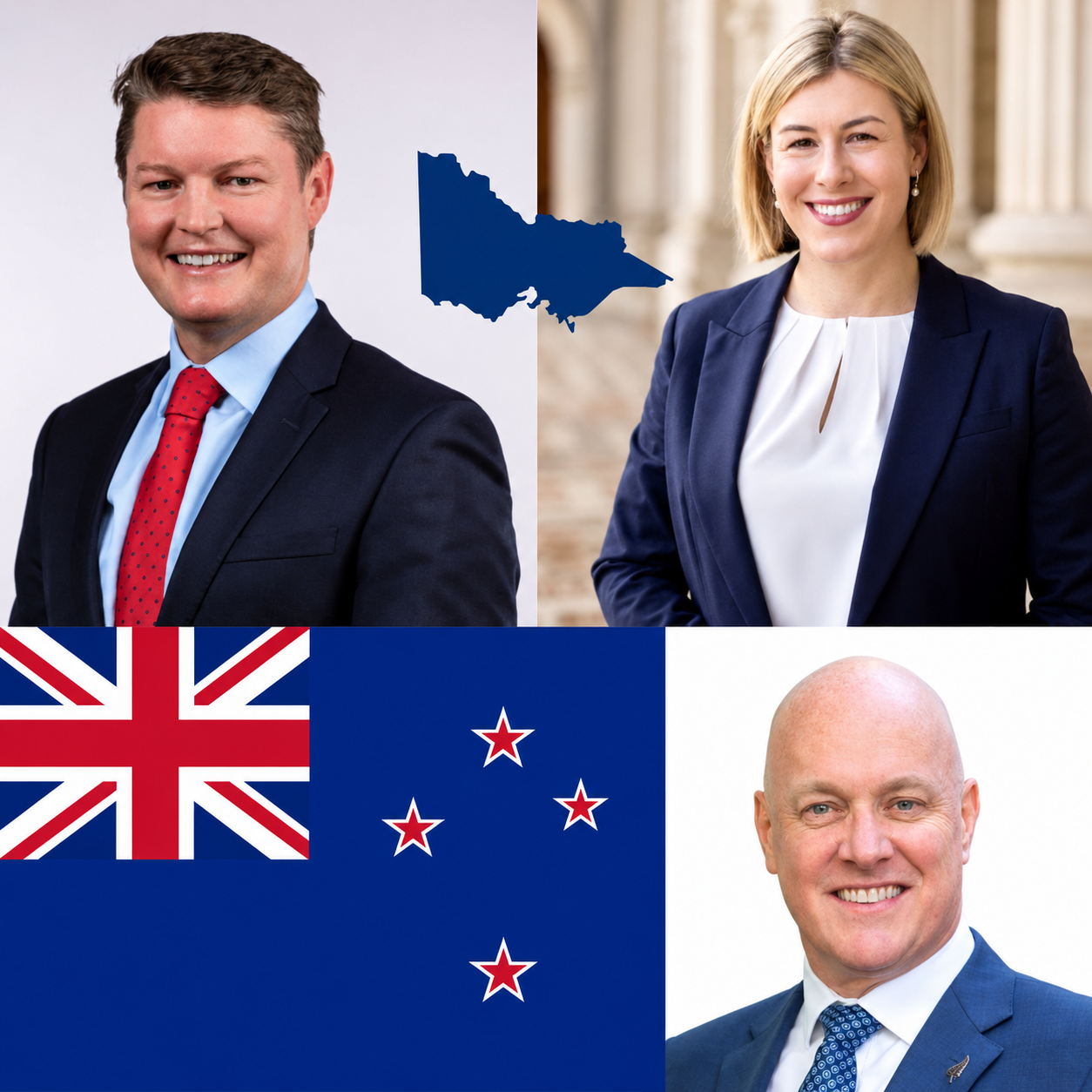

Cast your eyes over politics in any country and common themes emerge: distrust in the established party system and red-hot anger about cost of living are at fever pitch, compounded by the inability of ordinary people to control either.
The looming Victoria state poll and New Zealand’s national election are prime examples.
New Zealanders go to the polls on the 7 November and the performance of the smaller parties will be as important as the head-to-head battle between Prime Minister Christopher Luxon and Labour leader Chris Hipkins.
Luxon is seeking a second term for the National-led government and the result will be determined by his ability to muster a parliamentary majority with the support of ACT and New Zealand First.
Labour has a path to government but likewise will rely heavily on support from the Greens and Te Pāti Māori.
New Zealand uses a Mixed Member Proportional system where people cast one vote for a local MP and one for a party. This fragments what’s already a highly atomised political landscape.
A September Taxpayers’ Union–Curia poll put National on 29 per cent, Labour on 25.9 percent, the Greens on 13.9 percent, ACT on 10.5 percent and New Zealand First on 8.4 percent.
Cost of living, economic management and government spending are central campaign issues, which is exactly what’s happening in Victoria where the election will be on 28 November.
Polling shows low support for Labor, the Liberals and One Nation with an electorate that is highly volatile.
A RedBridge/Accent poll conducted between 1-14 September showed the Coalition on 29 percent, Labor on 24 percent, One Nation on 25 percent and the Greens on 15 percent. Assuming that pollster’s assumptions about preferences are correct, that would deliver Jess Wilson’s Coalition a 56–44 seat win.
Resolve polling conducted from 6-12 September had the Coalition (28 percent) heading Labor (25 percent) and One Nation (23 percent) and put Wilson ahead of Premier Ben Carroll (28–20 percent) as preferred state leader.
Carroll is distancing himself from predecessors Jacinta Allan and Dan Andrews on everything from crime and corruption to infrastructure spending blow-outs.
He’s playing catch-up football in the fourth quarter and has left his run late.
Wilson is trying to make the election a referendum about 12 years of Labor government, focusing on crime, debt, taxes and service delivery – like an epidemic of potholes.
The challenge for all is that each party’s primary vote is universally low, and results will come down to preferences and hand-to-hand combat in individual seats.

