
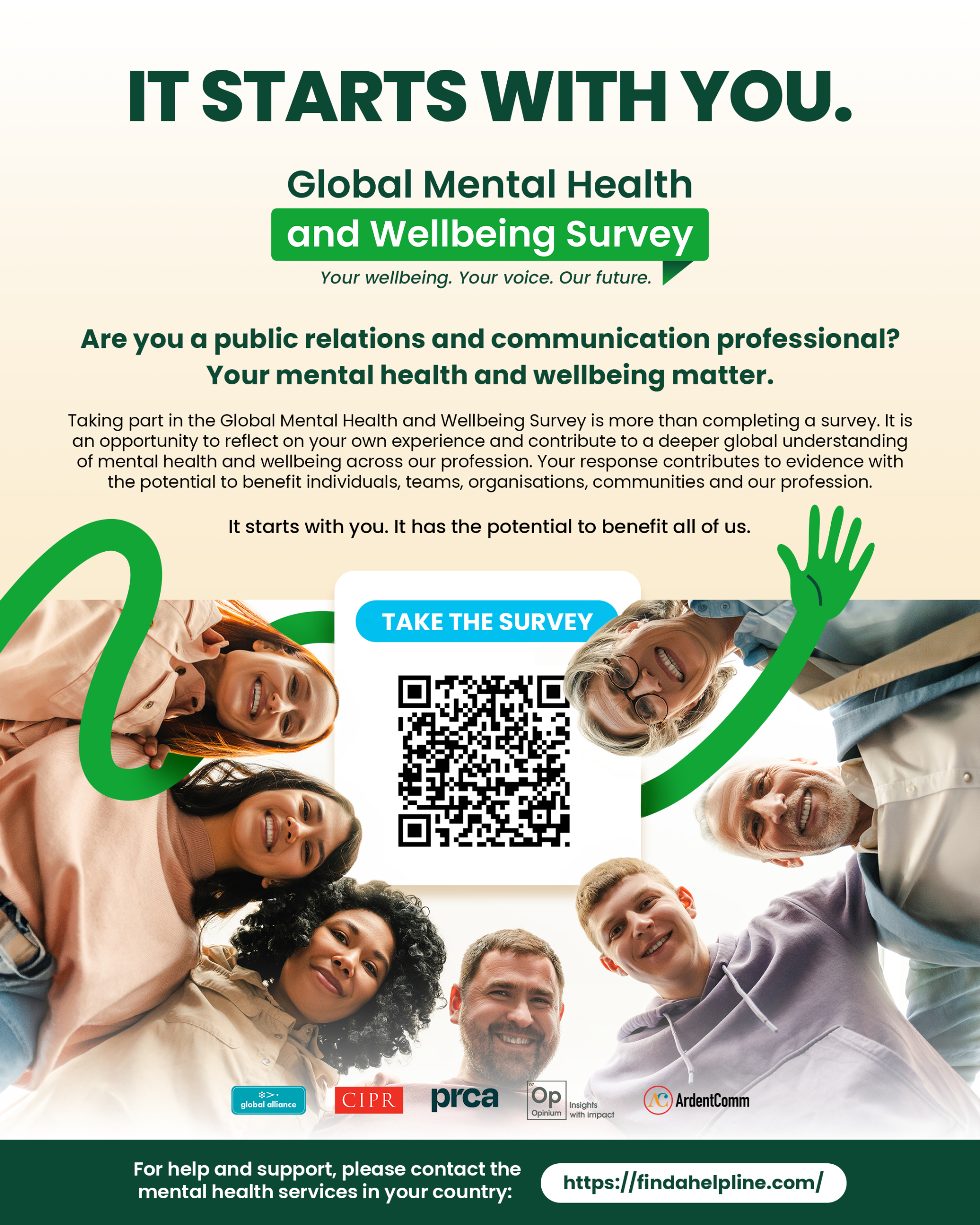

For the first time, public relations and communication professionals around the world are being invited to share their experiences as part of a new global study examining mental health and wellbeing across the profession.
The Global Mental Health and Wellbeing Survey opened on 5 October 2026 and is seeking to hear from more than 5,000 PR and communication professionals across seven global regions.
The initiative, led through the Global Alliance for Public Relations and Communication Management (Global Alliance), aims to establish the profession’s first credible global benchmark for mental health and wellbeing.
PR and communication can be rewarding, fast-paced and highly influential, but the nature of the work can also bring significant pressure.
Tight deadlines, demanding stakeholders, always-on communication, crisis situations and the expectation to respond quickly across multiple channels can all contribute to the pressures experienced by people working in the profession.
Yet without robust global data, it is difficult to understand how these experiences differ across countries, sectors, career stages and roles or where the greatest challenges and opportunities for change lie.
That is why broad participation is so important. The survey is designed to capture the experiences of professionals across different markets, cultures, disciplines, sectors and career stages, creating a more comprehensive picture of mental health and wellbeing across the global profession.
Have your say
The survey is anonymous and open to PR and communication professionals worldwide. It takes just a few minutes to complete, and every response will help build a stronger evidence base for the profession.
We encourage you to take part and share the survey with colleagues, peers and professional networks.
Take part in the Global Mental Health and Wellbeing Survey here.
The survey closes on 30 November 2026, with the results due to be announced in January 2027 as part of the Global Alliance’s Health and Wellbeing Month.
The findings will provide an important opportunity for the profession to listen to its people; understand the challenges they face and identify where greater support and healthier approaches to working are needed.

