
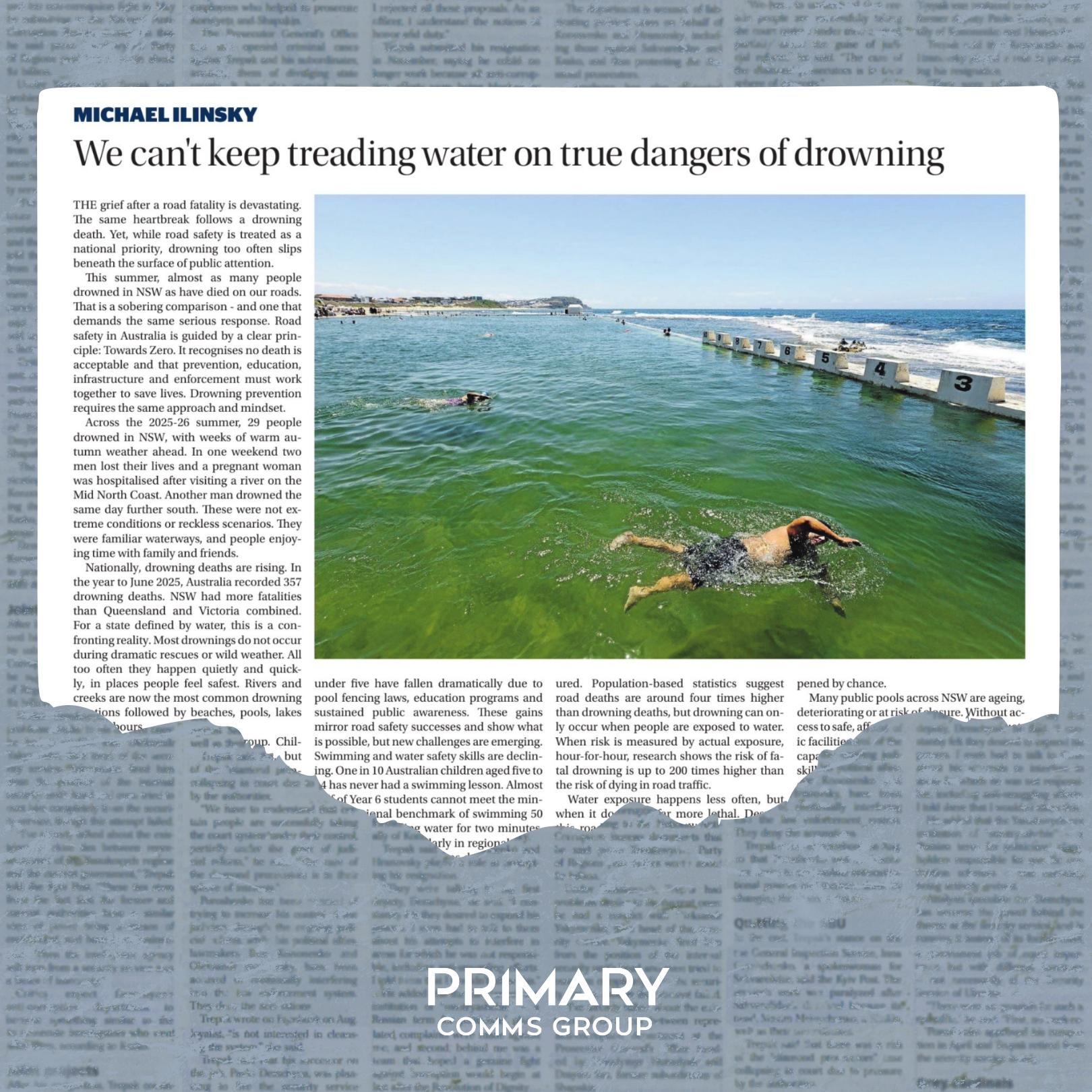

The below opinion piece by Royal Life Saving CEO Michael Ilinsky was originally published in the Newcastle Herald. The article explores why drowning prevention should be treated with the same urgency and national commitment as road safety.
Primary Comms Group is proud to be working with Royal Life Saving NSW to support awareness and advocacy around drowning prevention and water safety across Australia.
++
Our target should be zero – because one drowning is one too many
The grief which follows a fatal road crash is devastating. Families are shattered, lives are permanently altered and communities mourn losses that should never have happened. The same heartbreak follows a drowning death. Yet, while road safety is treated as a national priority, drowning too often slips beneath the surface of public attention.
This summer, almost as many people drowned in New South Wales as have died on our roads. That is a sobering comparison – and one that demands the same serious response. Road safety in Australia is guided by a clear principle: Towards Zero. It recognises that no death is acceptable and that prevention, education, infrastructure and enforcement must work together to save lives. Drowning prevention requires the same approach and mindset.
Across the 2025-26 summer, 29 people drowned in NSW, with weeks of warm Autumn weather still to come. Over a recent weekend, two men lost their lives and a pregnant woman was hospitalised after visiting what appeared to be a calm river on the Mid North Coast. Another man drowned the same day further south. These were not extreme conditions or reckless scenarios. They were familiar waterways, visited by people enjoying time with family and friends – exactly how many of us spend summer.
Nationally, drowning deaths are rising. In the 12 months to June 2025, Australia recorded 357 drowning deaths. NSW remains the deadliest state, with more fatalities than Queensland and Victoria combined. For a state defined by water, this is a confronting reality.
Most drownings do not occur during dramatic rescues or wild weather. All too often they happen quietly and quickly, often in places people feel safest. Rivers and creeks are now the most common drowning locations, followed by beaches, pools, lakes and harbours.
Drowning affects every age group. Children, rightly, remain a critical focus, but one in three drowning deaths last year involved someone aged over 65. Many older Australians lead active lives around water, yet reduced strength, medical conditions and outdated swimming skills can significantly increase risk – particularly in familiar environments close to home. Young people face different dangers, with drowning rates rising sharply from adolescence into early adulthood, especially when swimming unsupervised or in unfamiliar waterways.
The encouraging news is that prevention works. Drowning deaths among children under five have fallen dramatically over time due to pool fencing laws, education programs and sustained public awareness. These gains mirror road safety successes and show what is possible when governments, communities and families commit to long-term action.
But new challenges are emerging. Swimming and water safety skills are declining. One in 10 Australian children aged five to 14 has never had a swimming lesson and, as a result, almost half of Year 6 students cannot meet the minimum national benchmark of swimming 50 metres and treading water for two minutes. Many schools, particularly in regional areas, struggle to deliver programs due to cost, access and staffing barriers.
For decades, drowning has been treated as a lower-order public safety issue compared with road trauma. This is not because the risk is lower, but because of how the risk is measured.
Population-based statistics suggest road deaths are around four times higher than drowning deaths. But drowning can only occur when people are exposed to water. When risk is measured properly – by actual exposure, hour-for-hour – research shows the risk of fatal drowning is up to 200 times higher than the risk of dying in road traffic.
In simple terms: roads are used frequently, so deaths look high when spread across the whole population. Water exposure happens less often, but when it does, it is far more lethal. Despite this, road safety attracts billions in sustained, whole-of-government investment, while drowning prevention relies largely on short-term grants, seasonal campaigns and volunteer services. There is no equivalent Safe System for water.
NSW has shown that cultural change is possible. Seatbelts, drink-driving laws, speed management and safer roads have saved countless lives. None of this happened by chance.
Critically, a genuine Safe System approach to drowning prevention must also prioritise aquatic infrastructure renewal. Many public pools across NSW are ageing, deteriorating or at risk of closure, particularly in regional and disadvantaged communities. Without access to safe, affordable and year-round aquatic facilities, opportunities to build swimming capability, water confidence and lifesaving skills are diminished. Infrastructure is not a secondary consideration – it is a foundational element of prevention.
Planning for the renewal and equitable distribution of aquatic facilities must form part of any serious long-term strategy, ensuring all NSW constituents have genuine access to appropriate, modern pools that support safe participation and future aquatic interaction. Our rivers, beaches and pools are central to our way of life. Enjoying them safely should not be a matter of luck. If we truly believe that one road death is one too many, then we must accept the same truth for drowning.
The principle of Towards Zero should not stop at the water’s edge, so let’s work together with the aim of zero drownings in our waterways because one drowning is one too many.
Michael Ilinsky – Chief Executive Officer | Royal Life Saving Society – Australia (NSW | ACT | TAS)

