
All posts by admin

Cyber-safety in an AI world: What Primary learnt at Infosecurity Europe 2026

This week marked the annual Infosecurity Europe conference, the leading event for the cyber security community held in London on 2-4 June. With the theme, “Building a Safer Cyber World”, Primary’s Senior Account Manager Renee de la Motte attended to learn about protecting people, assets and data in today’s rapidly evolving threat landscape.

It was clear from keynote presentations throughout the event that AI is the most undeniable cyber threat facing us today. The rapid speed at which AI agents like Chat GPT, Copilot and Gemini are making their way into our workplaces (and into the hands of attackers) is creating a minefield of risk. Just as businesses implement AI processed to automate manual tasks and improve productivity, attackers are using AI to speed up their cyber attacks, launching them with more ease than ever before.

As AI continues to make its way into every aspect of our professional and personal lives, it will become increasingly difficult to ensure it’s being used for good purposes only. That’s why the guardrails have to be put in place now. Organisations need to educate all employees on the dangers of unfettered AI use, asking questions like “What confidential data are they putting into these chatbots, and what could be the consequences if this were to be exposed?” Because of how widespread AI use has become, organisations need to set clear policies regarding the use of AI and monitor for employee breaches of this.

This brings us to another key trend from the event; cyber security is no longer an issue reserved for the IT department. It’s now a whole-of-organisation issue affecting everyone from interns, to accounting teams, PR and marketing, right up to C-level Executives. Jesse McGraw, a reformed hacker turned security professional, went even further during his panel session, saying that cyber security has now become a societal issue. He argues if it’s so easy to use AI for bad purposes, then we must educate and train people of all ages, walks of life, and professional backgrounds on how to use AI for good. Otherwise, disenfranchised groups may be attracted to cybercrime without knowing the full dangers associated with this.

Another concerning trend was the emergence of triple-extortion ransomware attacks and shift in attacker behaviour. These days, many attackers have moved beyond the traditional single-stage encryption attacks, where an organisations data is encrypted and held by attackers until the ransom is paid. Increasingly, ransomware attacks are now multi-pronged schemes involving psychological pressure and even physical attacks on individuals, to wear them down and increase the likelihood of ransomware payment. These attacks cross a new ethical line, making it more difficult for organisations to say no to ransomware. Even the most well-prepared CISO won’t tolerate a threatening message against their family.

Overall, the event taught attendees that as cyber criminals’ tactics rapidly evolve, we must continue to evolve alongside them. Although it feels like things are moving at an unstoppable pace, we must double down on cyber security education to help people

Renee de la Motte is Senior Account Manager
Behind the Budget: Canberra’s push for economic resilience

From beneath the mountain of Budget papers (yes they are still a thing even in this digital age), forecasts and Treasury jargon, one thing is clear; this is not simply a fiscal roadmap for the year ahead. It is Canberra signalling that Australia needs to be prepared for the next geopolitical shock, in whatever shape it may arrive. 

And as with any Budget handed down in Canberra’s halls of power, the real question is simpler than the very many spreadsheets produced – does any of it pass the pub test? 

Whether it is housing, energy, manufacturing, fuel security or skilled migration, the Government is clearly trying to reposition Australia for a world that is becoming less stable, less predictable and far more economically fragmented. 

Through exclusive drops to media outlets in the lead-up, there weren’t too many big surprises – there rarely are – but what we did know is that housing would be front and centre in the Treasurer’s pitch to the nation and would be framed as the defining intergenerational challenge facing modern Australia. 

The Government is trying to attack the crisis from both ends – boosting supply while tweaking tax and infrastructure settings needed to actually get homes built. The headline measure is the $2 billion Local Infrastructure Fund, aimed at unlocking the roads, water, sewerage and utilities needed for new developments to proceed. 

Canberra says the fund could help deliver up to 65,000 homes over the next decade. Industry groups reckon the number could actually climb much higher if approvals and workforce shortages are also addressed. 

Importantly, $500 million has been ringfenced for regional Australia. This appears to be an acknowledgement that housing stress is no longer just a Sydney or Melbourne problem. Regional centres are feeling the squeeze too. 

And frankly, this is where the pub test starts to bite. Most Australians understand you cannot build homes without the pipes, power and roads to support them. The frustration has never been about a lack of announcements; it has been about whether these much-needed projects actually get moving before another generation is locked out of the market. 

One of the major threads running through this fiscal forecast is intergenerational fairness. A Government which is becoming increasingly aware that social cohesion becomes shaky ground if younger Australians believe the economic ladder has been yanked away from them. Increasingly, economic resilience and social stability are becoming one and the same. 

Nowhere is that shift clearer than in energy and fuel security. For decades, Australia operated on the assumption that global supply chains would always remain cheap, reliable and politically stable. The pandemic wounded that illusion. Growing geopolitical tensions have buried it. 

This Budget makes clear that sovereignty is no longer just about submarines and defence spending. It is also about fuel reserves, fertiliser production, gas supply and domestic manufacturing capability. 

At the same time, the Government is walking a political tightrope with a dual-track energy strategy, continuing with a level of investment in future industries while openly acknowledging that gas still underpins large parts of Australia’s industrial economy and energy reliability. The proposed 20 per cent domestic gas reservation scheme, due to begin mid-next year, could become one of the most consequential energy reforms in decades. Requiring LNG exporters to reserve supply for the domestic market reflects a broader global shift toward economic nationalism and sovereign capability. 

Critics will claim market intervention but plenty of Australians have been asking a fairly blunt question over a quiet one at the local – how does one of the world’s largest gas exporters still end up with soaring power bills and supply shortages? 

Manufacturing and logistics businesses will also gain access to interest-free loans through the National Reconstruction Fund’s $1 billion Economic Resilience Program – another sign Canberra is trying to rebuild domestic capability in sectors deemed strategically critical. 

The message underneath it all is hard to miss; Australia can no longer assume overseas production lines will always deliver what we need, when we need it. If the pandemic exposed cracks in global supply chains, rising geopolitical tensions have widened them even further. 

For now, Australians may simply be asking the oldest Budget question of all; after all the headlines and promises, will any of this actually make life easier around the kitchen table? 

Frank Coletta, Senior Executive, Strategy & Public Affairs

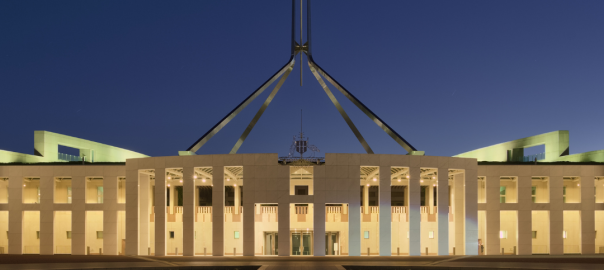
Image: Parliament House, Canberra, via Wikimedia Commons